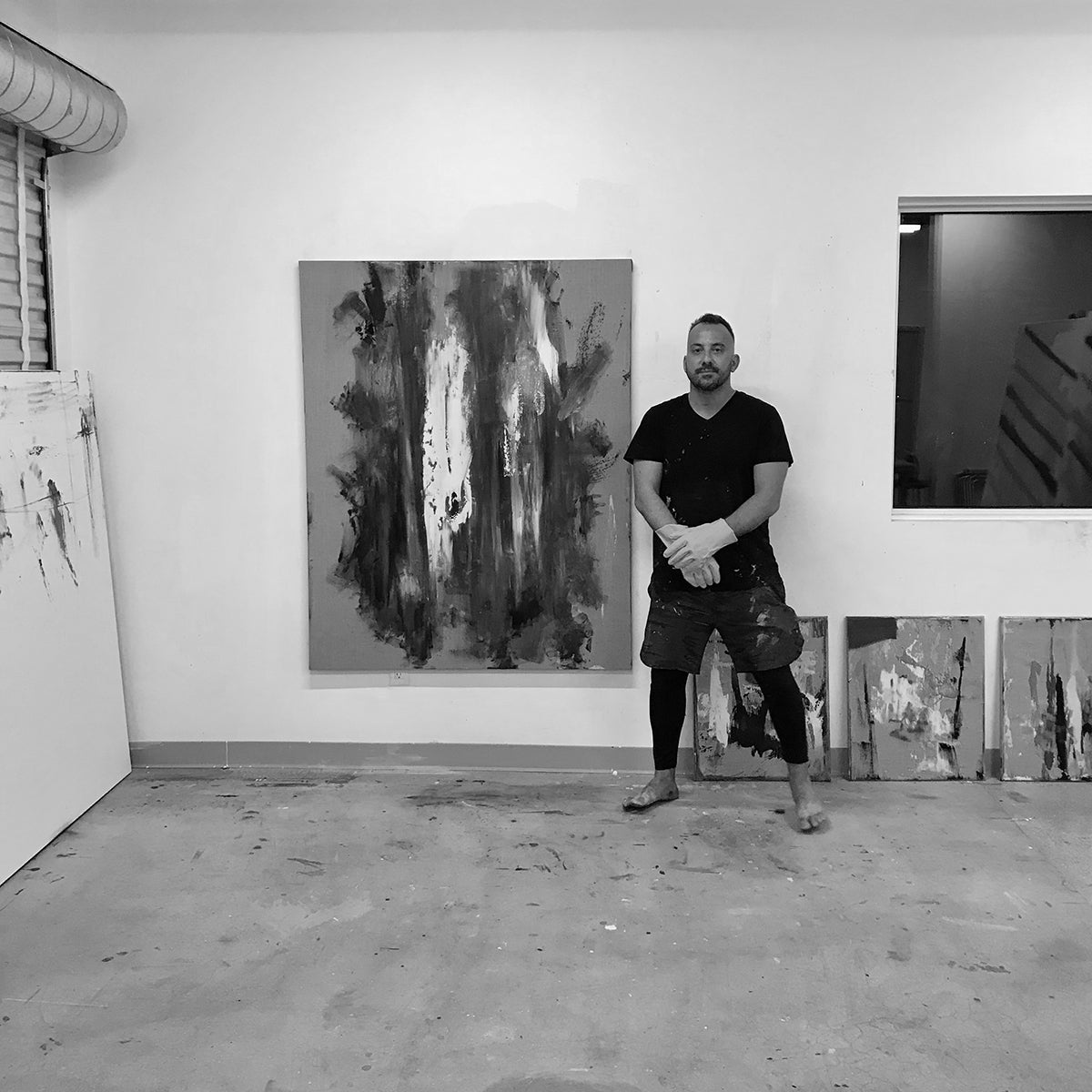


Meet Tommaso Fattovich, the self-taught painter who’s shaking up the art world with his raw, unfiltered approach. Born in Milan and now based in Boca Raton, Florida, Fattovich has spent his life navigating between two vastly different cultures—an influence that permeates his striking works. Fattovich’s style, which he fittingly dubs “Abstract Punk,” is a visceral rejection of traditional techniques in favor of bold, brut art strategies. His large-scale canvases are built from layers of oils, acrylics, and unconventional tools—think plaster trowels and forks—adding dimension and texture that commands attention.
Available now through Wester Gallery’s online collection, Fattovich’s compositions are more than paintings—they’re experiences. In this exclusive Q+A, we explore the inspirations behind his distinctive process, how he taps into an authentic inner world, and what drives his determination to create art on his own terms. From Milan’s artistic pulse to the vibrant Wynwood Art District in Miami, Fattovich’s journey is as captivating as the work itself.
Discover his series available now at Wester Gallery Online and experience the energy that makes Tommaso Fattovich’s art truly one-of-a-kind.
Welcome! To kick things off, could you tell us a bit about yourself and your artistic journey and what led you to the style you work with today?
Thank you! I’m very excited to be part of your roster of artists and your questions are very interesting. They really do invite conversation and that’s what art is about: communicating, sharing ideas and building bridges. To answer your question: I was born and raised in Italy. My family and I moved to Florida during my teenage years. In Italy we were taught art history since elementary school, however my hands-on artistic journey began in Florida when my brother and I started a metal band and made short films. In fact, my first intention creatively was to make movies and music videos. I discovered painting later in life. I’m 47 years old and started painting in my mid-30s. What led to the style I work with today was a series of experiments without having a defined style in mind but rather enjoying the process of discovering what works visually. For example, examining tension between brush strokes and certain colours; I also like to explore a variety of styles from spray painting on a canvas or purely using oils or combining both - but ultimately, I like to make each piece different from each other. I don’t like to create variations of the same thing.
Your art has a distinct voice that’s both raw and refined, can you describe the moment or piece that you feel really defined your current artistic identity?
I think my artistic identity is embedded in my curiosity and need to experiment – anything from photography to making music or drawing, and editing videos.
In regards, to painting what defined my artistic identity was the ability to connect with an audience using this medium.
Wester is all about the intersection of visual narratives and personal stories. How do personal experiences shape the themes you explore in your work?
Certainly growing up in two different cultures (Europe and U.S.) has had an impact on my visual language appreciating the graffiti side from living in Milano and then exploring the streets of Miami; growing up seeing monuments and churches to then beaches and palm trees; what really shapes the themes in my work is the music I listen to, however the paintings I start with an idea in mind never end up happening. While painting, I am always led to a new idea.

Use this text to share information about your brand with your customers. Describe a product, share announcements, or welcome customers to your store.
We’re always interested in the diverse methods that artist use. Are there any unusual techniques that might play a key role in your works?
Not sure if there is anything unusual I can point out in my technique. I use acrylics, oils and turpentine, a million brushes and sometimes forks (very basic set up). What’s maybe unusual is that I don’t paint every day. I make my painting sessions an event I carefully prepare and approach ritualistically once per month for a week straight. I need to feel pulled into the studio because I miss it, and that urge is what gives me the fire to create.
Inspiration can be found in the most unexpected places. Can you share an unusual source of inspiration that has surprised you with the impact it has had on your work?
I have started reading books about other artists I admire like Cy Twombly, Franz Kline and Donald Judd. Reading the books and obviously looking at the images of these superb works of art is certainly inspiring. I also love scrolling through social media and seeing what other artists do it is a good source of inspiration. The impact on my work from this is that I am reminded to be free and try anything I want. It’s all rooted in experimentation.
Many artists are deeply influenced by their environments. Does your geographical location or cultural background shape your artistic expressions?
I must say that I am still trying to figure out if my geography or my cultural background influences my imagination. Subconsciously probably there’s an influence.


Are there any challenging projects you have undertaken? And what you may have learned from that experience?
Yes – I took on doing a mural and didn’t like the experience – it became almost like a “wall painting job” – it took too long and I didn’t get to experiment.
Do you have a piece with a particularly meaningful backstory or significant value? Could you share its story with us?
The first piece I sold has meaning to me because it helped me build the confidence to keep going and making more paintings.
Art can often challenge or comfort. Do you aim for your work to provoke, soother, perhaps a bit of both? How do you balance these elements? And are they at the forefront when creating?
Great question. The aim is to have fun. Then edit later. Meaning the idea is to get lost first in the painting without any real intention behind it, and then help the painting find its way by editing and fine tuning various sections to make it work as a whole.
Sustainability and art are increasingly intersecting. How do you consider environmental or ethical factors in your practice?
I am not informed on this subject and not sure what it means.
How has social media's transformation of art sharing and rapid image consumption impacted your career, and how do you navigate the commercial pressures of the art market?
Love this question. Social media in the beginning for me created a false sense of urgency to keep creating…”oh so and so made a new work of art, hurry, I need to make one too now!”… I have learned to just reel it in, and just be at ease with where I am. Things have a way to come together for everyone when heart and soul are at peace, and you are happy with your final art work.

Use this text to share information about your brand with your customers. Describe a product, share announcements, or welcome customers to your store.